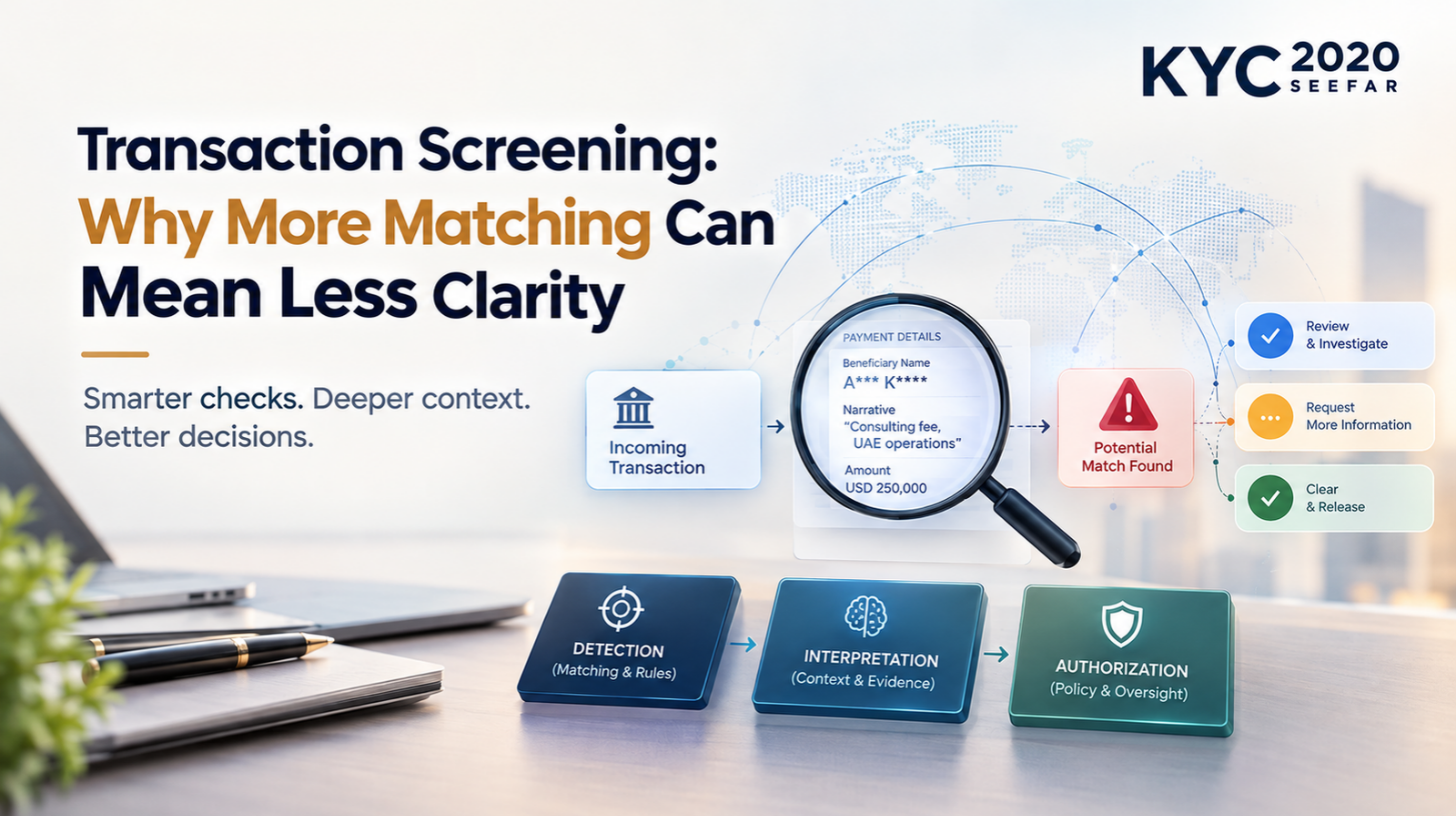
A cross-border payment arrives with a short narrative: “consulting fee, UAE operations.” The beneficiary’s name resembles a sanctions-list entry. The screening engine raises an alert, and the payment waits while an analyst checks the details. Yet the uncertainty may have started before matching: what does the narrative mean, which fields matter, and which signals justify escalation?
This is the operational weakness behind many transaction-screening delays. The challenge is not simply finding more possible matches. It is deciding what to screen, interpreting the signals correctly, and validating the outcome without weakening mandatory controls.
What Transaction Screening Software Must Decide Before Matching
Payment messages contain structured fields alongside free text, abbreviations, incomplete identifiers, and inconsistent formats. A broad screening approach may send every fragment through every check because excluding a relevant detail feels risky. That defensive choice can create noisy alerts, repeated manual reviews, and avoidable payment holds.
A stronger process first establishes screening scope. It preserves the original message, creates a structured representation of the available information, and adds contextual details where appropriate. With the help of transaction screening software, the original data must remain available: normalization should clarify a message, not silently replace what the sender supplied. Screening then applies the lists, identifiers, and rules required by policy and the relevant payment context.
Why Tuning Matching Rules Cannot Solve Every Alert
Suppose a beneficiary’s name is similar to a listed person, while the payment narrative points to an ordinary commercial service. Lowering the matching threshold may catch more spelling variants, but it also brings unrelated names into the queue. Raising it may reduce noise while missing genuine matches written in a different transliteration.
This is the familiar trade-off between recall and precision, but transaction screening software adds another complication: uncertainty in the payment data itself. A name score cannot establish whether a payment is prohibited, and a low-risk narrative cannot cancel a mandatory sanctions match. Matching produces signals; it does not, by itself, make the payment decision.
Separate Detection, Interpretation, and Authorization
These tasks require different controls. Deterministic rules should enforce non-negotiable obligations, including applicable sanctions and jurisdictional restrictions. Contextual models can help interpret free-text narratives, name variations, and relationships that rigid rules may not understand. Their role is to inform the assessment, not to authorize a payment.
A governed workflow evaluates these contributions independently and reconciles them against policy. When the evidence agrees, and policy permits automation, the system can proceed within approved boundaries. When results conflict, identifiers are incomplete, or a mandatory trigger appears, disagreement becomes a reason to validate or escalate—not a reason to average the signals into a reassuring score.
Make Uncertainty Visible And Decisions Reproducible
Consider the earlier payment. The name similarity triggers a check, but the narrative, beneficiary details, and jurisdiction indicators do not all point in the same direction. A defensible system records each signal, preserves the raw message and structured interpretation, explains which rule applied, and routes the case according to the institution’s policy. An analyst can then see why the alert arose rather than reconstructing the reasoning from scattered logs.
Every outcome should retain the list source, matching logic, relevant evidence, model or rule contributions, timestamps, reviewer actions, and final authorization. This supports internal review, audit, and later reconstruction. AI explanations should be tied to source data, and missing evidence should remain an explicit limitation. No model should silently clear a transaction simply because its interpretation sounds plausible.
Evaluate the Whole Decision Process, Not Just Speed
When assessing a transaction screening software solution, test ambiguous narratives, abbreviations, partial identifiers, transliterations, genuine matches, and benign near-matches. Measure false-positive rates alongside missed-match testing, escalation quality, decision latency and audit completeness. A fast system that hides uncertainty is not efficient; neither is a cautious system that sends every ambiguity to a human. Testing helps teams locate failures in data preparation, matching, interpretation, or authorization without weakening safeguards across the process overall.
KYC2020’s RDS-HIVE framework separates scope determination, signal interpretation, and validation, using deterministic controls to govern final authorization. This architecture is designed to reduce unnecessary escalation while preserving policy oversight and traceability; actual performance should be assessed against each institution’s own scenarios and risk obligations.
The goal is not to screen less at any cost or to automate every payment. It is to apply the right checks to the right information, explain why a signal matters, and make the final outcome defensible. When detection, interpretation, and authorization remain distinct, institutions can manage real-time payment pressure without confusing an alert with a decision.