A payment business expands into a new market, serves higher-risk customers, adds a digital product and relies on third-party agents. Yet its AML risk assessment still reflects last year’s operations.
The challenge is not simply assigning high, medium or low ratings. It is identifying where money laundering could occur, evaluating whether controls address those exposures, and documenting what must change.
What Aml Risk Assessment Software Should Actually Assess
An effective assessment starts with the business, not a generic template. Products and services create different exposure depending on transaction speed, anonymity, cash access or cross-border movement. Customer risk varies with customer types, ownership structures, activity and expected behaviour. Geography matters where jurisdictions differ in exposure to financial crime, sanctions or weaknesses in controls.
Operational risk examines whether policies, training, record keeping, transaction monitoring and escalation work in practice. Agents and other third parties introduce another layer: the organisation must understand what they do, which customers or payments they handle, and whether their controls are adequate.
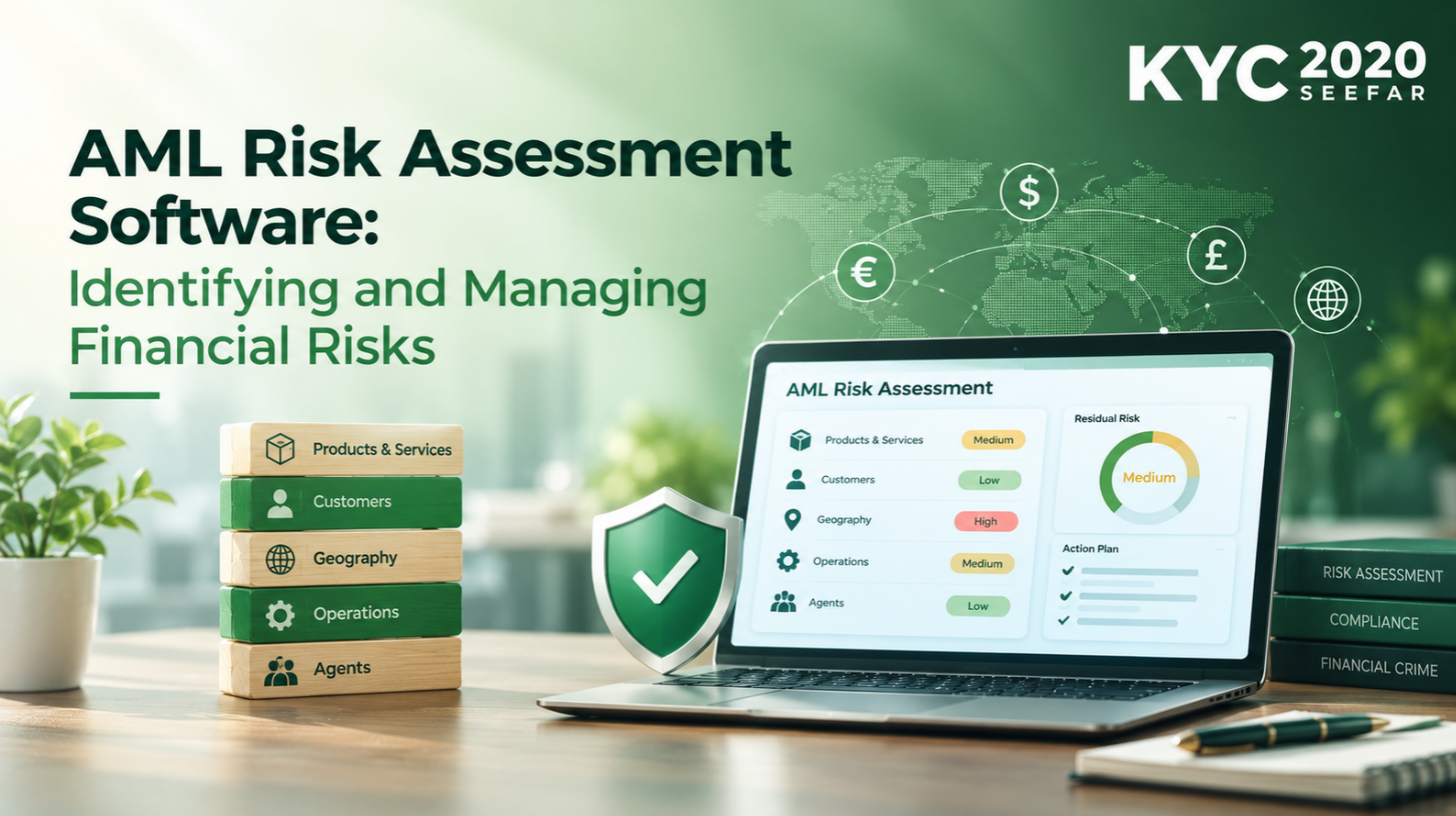
KYC2020’s AML risk assessment framework groups assessment around five categories: products and services, customers, geography, operations, and agents.
Why Inherent Risk Is Not The Final Answer
Consider a payment provider serving international merchants. Cross-border transfers and complex ownership may create high inherent risk before safeguards are considered. The provider applies customer due diligence, sanctions screening, transaction monitoring, staff training and escalation procedures.
Those controls may reduce exposure, but their presence alone does not prove effectiveness. A policy may be poorly followed; a monitoring rule may generate alerts that no one reviews promptly. A credible assessment distinguishes inherent risk—the exposure before controls—from residual risk, the exposure that remains after controls are evaluated.
This distinction matters. If software lowers a score merely because a control is listed, it can create false reassurance. The assessment should record what the control does, who owns it, how consistently it operates, what evidence supports its effectiveness and where gaps remain.
Why A Single Score Can Hide Important Weaknesses
An aggregate score makes results easier to compare, but it can conceal a serious weakness in one category. Strong training and documentation do not necessarily compensate for inadequate transaction monitoring in a high-risk payment channel. Nor should a low-risk product automatically offset exposure from opaque customer ownership.
Risk assessment software should preserve category-level findings alongside the overall rating. Configurable definitions for high, medium and low risk help organisations reflect their products, customer base and risk appetite. The rationale behind each rating should remain visible, so a reviewer understands why a category received its score rather than simply accepting a number.
Where evidence is incomplete, the system should identify the gap instead of implying certainty. Human review remains necessary when judgements depend on context, conflicting evidence or specialist interpretation.
Turn The Assessment Into An Action Plan
An assessment is useful only when it changes decisions. Each material gap should lead to a proportionate response: strengthen due diligence for a customer segment, adjust monitoring coverage, review an agent, improve staff training or assign an owner to remediate weak record keeping.
The action plan should define responsibility, priority, deadlines and evidence of completion. It should connect each finding to the control intended to address it. A risk rating without follow-up is merely a record of concern, not risk management.
Software can structure inputs, apply consistent scoring criteria, retain supporting rationale and produce a report for review. Templates reduce the burden of starting from scratch, but must be adapted to the organisation rather than treated as a substitute for analysis.
Keep The Assessment Current And Defensible
A risk assessment should be revisited when the business launches a product, enters a new market, changes its customer mix, adopts a new delivery channel or discovers a failing control. Periodic review matters, but significant changes should not wait for the next annual exercise.
When evaluating AML risk assessment software, look for configurable risk definitions, category-level and residual-risk scoring, evidence records, version history, action ownership and reports explaining how conclusions were reached. Check whether the workflow supports reassessment as well as initial completion. A polished dashboard is less valuable if it cannot show the reasoning behind a rating.
The objective is not to produce the lowest possible risk score. It is to understand exposure honestly, test whether controls work and direct resources towards the weaknesses that matter most. Good AML risk assessment software makes that reasoning consistent and traceable; accountable people must still interpret the evidence and act on it.