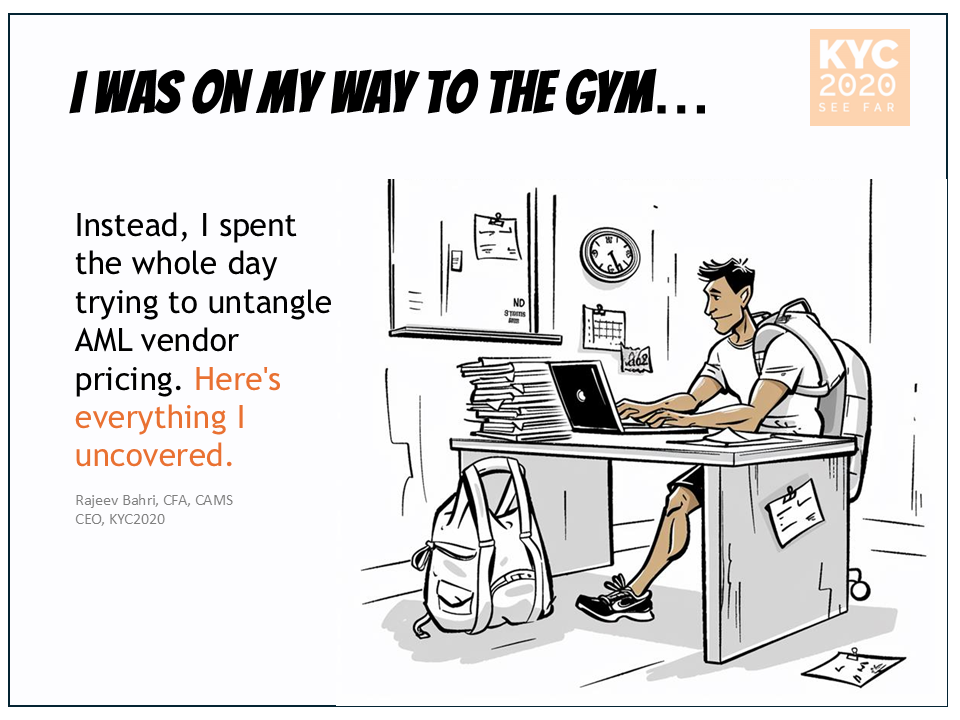
I Was on My Way to the Gym. Instead, I Spent the Day Trying to Untangle AML Vendor Pricing.
A CEO’s honest account of a one-hour detour that turned into an all-day project — and what it reveals about AML vendor pricing transparency in 2026.
It Started as a Trivial Exercise
Yesterday, my marketing team got into one of those spirited debates that somehow consume an entire afternoon. The topic: our 2026 pricing strategy. And not just retail pricing — we are actively building out our reseller and integration partner network, which means we also need to think about wholesale pricing. Before you can set a wholesale rate intelligently, you need to understand where the market sits on retail. So the real question on the table was: what are the major AML and FRAML vendors actually charging at standard volumes, and where does KYC2020 fit in that landscape?
I listened for a few minutes and then, I will be honest, I trivialized it. I said something along the lines of: “Come on, it’s 2026. We have AI. Give me an hour and I’ll pull together a competitive pricing comparison and we can base the whole conversation on real data.”
I had my gym bag packed. I was literally heading out the door. I figured: one hour, maybe ninety minutes, and I would have a clean comparison table of what the major AML and FRAML vendors charge at standard retail volumes.
I did not make it to the gym.
The Feature Parity Problem
If you have evaluated AML screening vendors recently, you have noticed something: everyone claims to do the same things. Every pitch deck includes global sanctions coverage, PEP screening, adverse media monitoring, ongoing monitoring, API access, AI-powered decisioning, low false positives, and audit-ready reporting.
The feature matrices look nearly identical. The terminology is similar. The sales pitches sound like they were written from the same template.
Now — this does not mean the vendors are the same. Data quality, matching accuracy, false positive rates, integration simplicity, support quality, and compliance depth vary enormously. But those differences require testing to discover. They are not visible from a features list.
Five Things That Make AML Pricing Hard to Compare
1 Most vendors do not publish prices
This is the first thing that slows you down. The majority of established AML vendors — LexisNexis, Dow Jones, Refinitiv World-Check, Onfido, Jumio, Veriff — do not publish pricing at all. Their contracts start at tens of thousands of dollars per year and require a sales conversation to even get a number.
That is fine for enterprise buyers with procurement teams and months of lead time. For a fintech, an MSB, a credit union, or a growing compliance programme trying to evaluate options quickly, it means half the market is effectively invisible from a pricing perspective.
Of the vendors that do publish pricing, the information ranges from genuinely clear and complete — rare — to partially disclosed, to technically published but practically inaccessible because the pricing page requires JavaScript interaction to reveal the actual numbers. I spent time on multiple vendor websites that simply would not render their pricing tables programmatically.
2 The unit of pricing varies fundamentally
This is the core structural problem. Vendors price their services in completely different units, and without converting everything to a common basis, comparisons are meaningless.
- NameScan charges per scan — pay as you go. Buy a pack of scans, use them within 12 months.
- ComplyAdvantage charges a monthly subscription based on monitored entities. One price covers unlimited screening and monitoring for those entities.
- AML Watcher also charges an annual entity-based subscription, but the price points are completely different from ComplyAdvantage.
- Sumsub charges per verification at onboarding. But ongoing monitoring is an additional cost on top — not obvious from the main pricing page.
- KYC2020 (my company) charges both ways: per scan for ad hoc use, or an annual entity-based plan that includes active monitoring.
Once I realised this, I understood why the comparison was hard. You cannot just line up the numbers. You have to normalise for the unit, the cadence, and the bundling before a single comparison is valid.
3 “Monitoring” does not mean the same thing
Active monitoring — the continuous re-screening of your customer base against updated watchlists and adverse media — is a core compliance requirement. But different vendors structure and price it in fundamentally different ways.
- Some vendors include monitoring in the base subscription. You pay for X entities, monitored continuously — no extra charge per re-screen.
- Other vendors charge for monitoring separately. The onboarding check is one price; each monitoring event is additional.
- Some vendors describe monitoring as “daily.” Others are less specific about frequency.
- The practical implication: if a vendor charges per monitoring scan and your entities are screened daily, the annual monitoring cost is 365 times the per-scan rate. This changes the total cost by orders of magnitude.
4 IDV — not all of it is included, and not all of it counts
Identity verification is increasingly expected as part of any complete compliance workflow. But two things make it hard to price: how vendors bundle it, and what it actually covers.
On bundling: Sumsub and KYC2020 include IDV in their base plans. NameScan charges it as an add-on at $2.00 per check. ComplyAdvantage does not offer IDV at all — you need a separate provider. AML Watcher is the same. For any fair comparison, you need to add the market cost of regulated-grade IDV — approximately $1.05–$1.50 per entity — to vendors that do not include it.
On what it covers: there is a meaningful compliance difference between document scanning with biometric face match — fraud prevention — and document scanning plus validation against a government-issued database — regulated-grade CDD. Some vendors promote free or near-free IDV; in most cases the free tier covers the former, not the latter.
Under FATF Recommendation 10 and equivalent national frameworks — FinCEN, FINTRAC, FCA, AMLD — regulated entities must verify identity through an independent and reliable source. Government database validation is not optional for most regulated programmes.
5 Even AI got confused — repeatedly
I used Claude to help me build this analysis. Claude is capable and genuinely helpful for research tasks. But I want to be direct: it made meaningful errors that I had to catch and correct, sometimes multiple times.
- It treated Sumsub’s monitoring as included in the $1.85 rate — an easy mistake given the main pricing page, but wrong.
- It applied monthly monitoring cadence multipliers to vendors that charge per onboarding, not per re-screen.
- It pulled stale pricing data from third-party review sites reflecting 2022 rates, not current figures.
- It extrapolated pricing tiers using discount slopes that were unrealistically aggressive for some vendors.
- It could not programmatically access JavaScript-rendered pricing pages, so it worked with incomplete information.
The Comparison I Was Able to Build
After a full day of research, cross-referencing sources, correcting AI errors, and building a normalised model from scratch, here is what I was able to construct. This covers five vendors — NameScan, Sumsub, ComplyAdvantage, AML Watcher, and KYC2020 — because these are the vendors with publicly available retail pricing in the volume tiers relevant to SMEs, fintechs, and mid-market compliance programmes (100 to 5,000 entities).
Orange-shaded cells indicate either (a) values estimated from published discount slopes, or (b) IDV costs that require a third-party provider — not a bundled feature. KYC2020 rows are highlighted in green. I am the CEO of KYC2020.
Table 1 — Feature availability by vendor
| Vendor | Sanctions + PEP | Adverse media | IDV + liveness | Monitoring | Published pricing | Min. entry |
|---|---|---|---|---|---|---|
| NameScan | ✓ | ✓ | Add-on $2 | ✗ Not offered | ✓ Yes | $152/yr |
| Sumsub | ✓ | ✓ | ✓ Bundled | ✓ Extra cost* | Partial | $299/mo |
| ComplyAdvantage | ✓ | ✓ | ✗ 3rd party ⁴ | ✓ Bundled | Partial | $99/mo |
| AML Watcher | ✓ | ✓ | ✗ 3rd party ⁴ | ✓ Bundled | ✓ Yes | $375/mo |
| KYC2020 | ✓ | ✓ | ✓ Bundled | ✓ Bundled | ✓ Yes | $152/yr |
Table 2 — Onboarding only (no ongoing monitoring) — annual total, USD
| Vendor | 100 | 500 | 1,000 | 2,000 | 5,000 | Monitoring |
|---|---|---|---|---|---|---|
| NameScan¹ — AML only | $240 | $870 | $1,600 | $2,200~ | $5,000~ | Not offered |
| NameScan¹ — AML + IDV | $440 | $1,870 | $3,600 | $6,200~ | $15,000~ | Not offered |
| KYC2020² — AML only | $152 | $560 | $1,040 | $1,820 | $3,700 | Not bundled |
| KYC2020² — AML + IDV | $257 | $933 | $2,090 | $3,760 | $8,550 | Not bundled |
| CA / AMLW / Sumsub | No published standalone screening price — contact sales | Cannot separate | ||||
Table 3 — FRAML: AML screening + active monitoring + IDV — annual cost, USD
Monitoring cadence assumed monthly (×12 scans/year) for unit cost derivation only — actual monitoring is daily. IDV charged once at onboarding. Orange = third-party IDV required.
| Vendor | Entities | Cost / Screen | AML Annual | IDV Annual | FRAML Total | Annual Cost per Managed Entity |
|---|---|---|---|---|---|---|
| KYC2020² | ||||||
| KYC2020² | 100 | $0.38 | $372 | $313 | $685 | $6.85 |
| 500 | $0.11 | $669 | $525 | $1,194 | $2.39 | |
| 1,000 | $0.11 | $1,339 | $1,050 | $2,389 | $2.39 | |
| 2,000 | $0.12 | $2,837 | $1,940 | $4,777 | $2.39 | |
| 5,000 | $0.08 | $4,789 | $4,850 | $9,639 | $1.93 | |
| Sumsub²* | ||||||
| Sumsub²* | 100 | — | — | Bundled | — | — |
| 500 | $0.08 | $480 | Bundled | $1,405 | $2.81 | |
| 1,000 | $0.08 | $960 | Bundled | $2,810 | $2.81 | |
| 2,000 | $0.08 | $1,920 | Bundled | $5,620 | $2.81 | |
| 5,000~ | $0.064~ | $3,840~ | Bundled | $11,340~ | $2.27~ | |
| ComplyAdvantage³ | ||||||
| ComplyAdvantage³ | 100 | $0.99 | $1,188 | $150 | $1,338 | $13.38 |
| 500 | $0.48 | $2,868 | $750 | $3,618 | $7.24 | |
| 1,000 | $0.27 | $3,228 | $1,200 | $4,428 | $4.43 | |
| 2,000 | $0.16 | $3,828 | $2,400 | $6,228 | $3.11 | |
| 5,000~ | $0.089~ | $5,328~ | $5,250 | $10,578~ | $2.12~ | |
| AML Watcher³ | ||||||
| AML Watcher³ | 100 | $3.75 | $4,500 | $150 | $4,650 | $46.50 |
| 500 | $0.75 | $4,500 | $750 | $5,250 | $10.50 | |
| 1,000 | $0.51 | $6,100 | $1,200 | $7,300 | $7.30 | |
| 2,000 | $0.37 | $8,850 | $2,400 | $11,250 | $5.63 | |
| 5,000 | $0.23 | $13,750 | $5,250 | $19,000 | $3.80 | |
What This Means for Buyers
Ask every vendor the same five questions before comparing prices
- Is monitoring included in the quoted price, or charged separately? What is the actual screening frequency?
- Is IDV included? Does it include government database validation — or document scan and biometric match only? For regulated entities, the former is a CDD requirement.
- Is the price per scan, per entity per month, or per entity per year?
- What is the minimum monthly or annual commitment?
- What does pricing look like at my actual expected volume — not the entry tier?
Do not trust pricing comparisons you have not built yourself — including this one
I built this model carefully, but it reflects my assumptions and my reading of publicly available information. My own company is in the table. Vendor pricing changes. Bundling changes. Before you make a procurement decision, go directly to each vendor’s pricing page, request a formal quote, and verify the numbers.
Price is a starting point, not a decision
The vendors in this comparison differ meaningfully in data quality, matching algorithms, false positive rates, audit trail capabilities, integration complexity, and compliance depth. Price gets you to a shortlist. Only testing tells you who should win.
And testing is harder than it sounds — and more important than most buyers realise.
Two vendors can charge the same, claim identical features, and produce completely different outcomes on the same name. Not because one is hiding something — but because the differences that matter are invisible until you deliberately test for them.
Does the algorithm catch name variants and transliterations without drowning you in false positives? Has threshold drift since go-live quietly reduced your detection rate? Are the lists you believe are active actually syncing? Are your adverse media filters clearing articles a regulator would expect you to review? Are matched alerts actually reaching your case management system?
These failures produce silence. No error messages. No escalations. Just a screening tool that looks like it’s working — until an examiner asks a question nobody on the team can answer.
This is exactly why we built CertIQ — an independent UAT and continuous match outcome testing tool that runs against live screening logic using real watchlist data. It tests name variant catching across nicknames, typos, transliterations, and culture-specific naming conventions. It validates list coverage, adverse media logic, and end-to-end alert delivery. And it produces a structured, auditor-ready report that demonstrates not just that your screening tool is deployed, but that you have validated it works.
If you are evaluating any AML screening vendor — including us — structured testing before you commit is not optional. → 5 Screening Problems You Won’t Find Without Testing
Transparency has value
Vendors who publish clear, complete pricing make the buyer’s life significantly easier. In a compliance context, pricing opacity is not just inconvenient — it is a risk. Buyers should reward transparency in their evaluation process.
A note for resellers and integrators
This pricing discovery pain does not stop at direct buyers. Resellers, technology integrators, compliance consultancies, and platforms embedding AML or FRAML capabilities face exactly the same opacity — and then have to solve it twice: once to understand what they are buying, again to price and present it to their own customers.
A reseller cannot price what they cannot understand. We experienced this firsthand — the question of wholesale and partner pricing was what triggered this entire exercise.
KYC2020 is actively building its reseller and partner network, with the same pricing transparency we apply to direct retail. No black-box wholesale negotiation. [email protected]
I Did Not Make It to the Gym
I started this exercise thinking it would take an hour. It took a day.
I hope this research saves some of you that day — and starts a broader conversation about what buyers, resellers, and the market deserve: pricing clarity as a norm, not an exception. Not because vendors are hiding anything — I do not believe that. But because the products are genuinely complex, the bundling decisions are legitimately different, and the market has not converged on a standard way of presenting comparable information.
If you found errors or want to continue the conversation, reach out to me via my assistant [email protected]. We will update this as vendor pricing evolves.
Notes & Methodology
All pricing data sourced from vendor pricing pages, technical documentation, and third-party review platforms. Data collected April 2026. Prices in USD unless otherwise noted.
¹ NameScan (Sapphire tier): AML published for 100–1,000 scans. 2,000 and 5,000 tiers estimated from discount slope. IDV at $2.00/entity (US/CA).
² KYC2020: Annual plan pricing published at kyc2020.com/pricing. IDV included in FRAML plan. Author is CEO of KYC2020.
² Sumsub (Compliance tier): $1.85/entity at onboarding covers IDV + AML. Ongoing monitoring charged separately at ~$0.08/scan. 100-entity tier unavailable at self-serve rates. 5,000-entity tier estimated.
³ ComplyAdvantage (Starter tier): Published for 100–2,000 entities. 5,000-entity tier estimated from slope. Starter caps at 2,000 entities. IDV not offered — $1.05–$1.50/entity assumed from market rates.
³ AML Watcher (Premium tier): All tiers published. IDV not offered — $1.05–$1.50/entity assumed from market rates.
IDV market rate assumption: $1.05–$1.50/entity for govt ID + selfie + liveness, based on published mid-market rates. This is an estimate and will vary by provider and volume.
Monitoring cadence: Monthly (×12 scans/year) used for unit cost analysis only. Active monitoring may run daily — this affects cost significantly for per-scan pricing models.