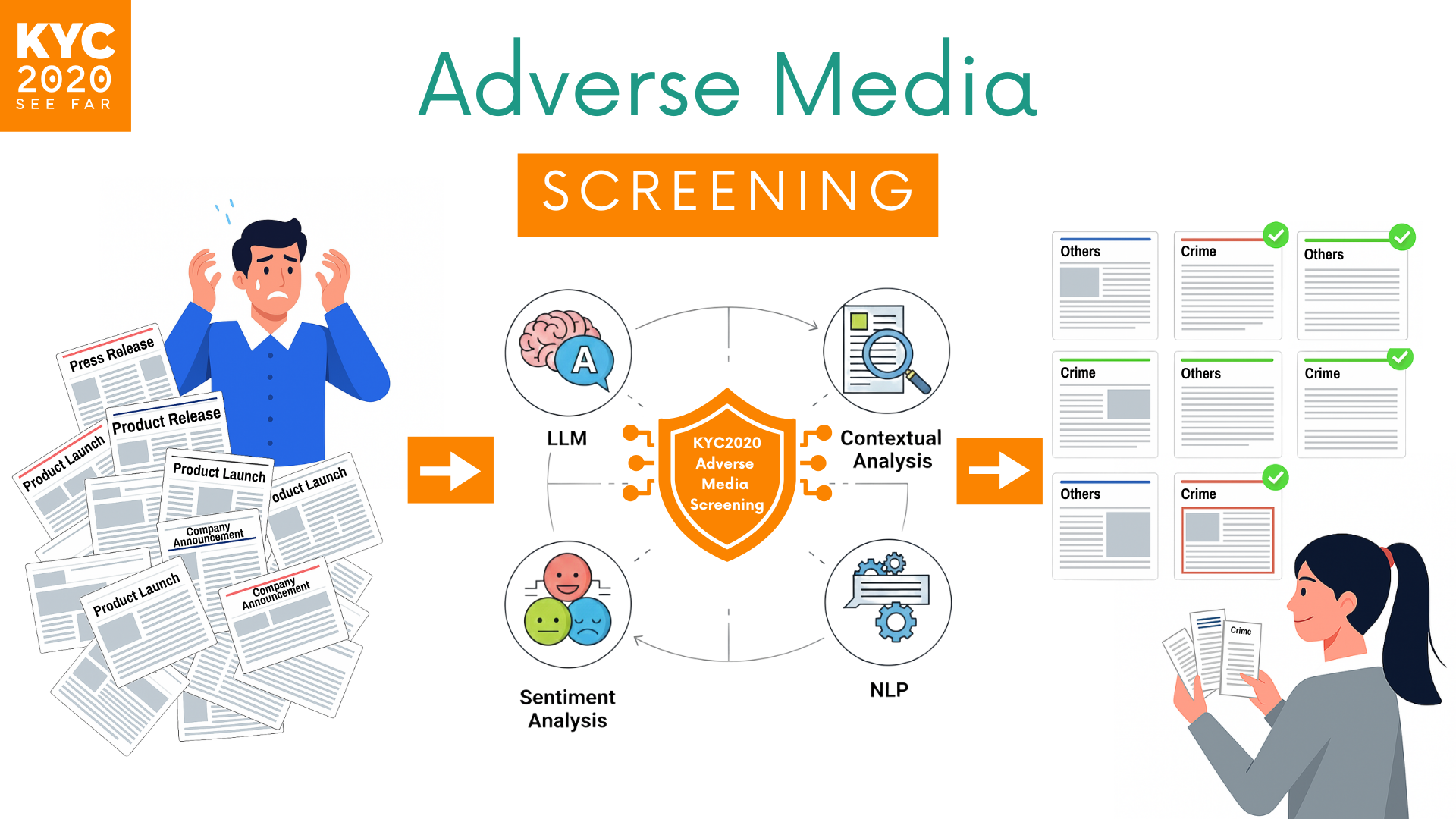
Adverse media screening, also called negative news screening, is meant to surface news that links a customer to financial crime. A recent screening flagged 14 articles on one customer. None of them were about that customer. Our adverse media engine is not a keyword search: it runs article classification, context analysis, natural language processing (NLP) that identifies the prime actor, sentiment scoring and offense categorization. It still made us look foolish. Here is why deterministic models break down on an exact match to a public figure when the prime actor and the sentiment sit on the edge, why large language models (LLMs) read those cases better, and what we built so it doesn’t happen again, without touching the deterministic decision our clients rely on.
14 adverse media hits, zero true positives
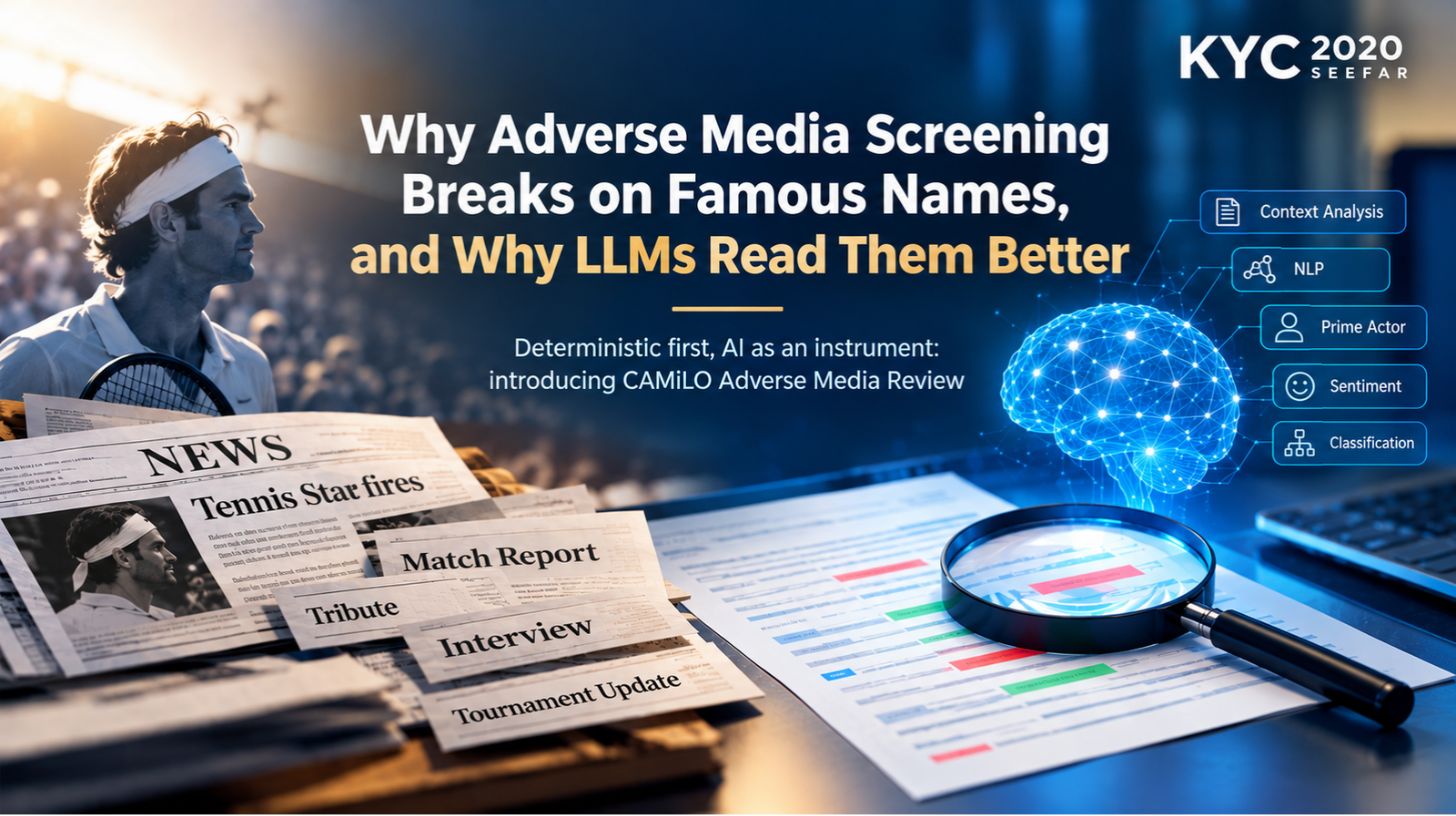
A customer shared a name with a globally famous tennis player. Our sanctions screening and decisioning engine found 20 exact-name adverse media hits, cleared 6 and left 14 for an analyst. None of the 14 was adverse for the customer: match reports, retirement tributes, other players’ interviews, and pages where the name appeared only in a sidebar. Every one had passed through our classification, context and sentiment models.
Why NLP and sentiment models miss edge cases in adverse media screening
NLP, sentiment and prime-actor models handle clear cases well. On edge cases, and even near-edge cases, they fall back on what they can measure: keywords and their density. A match report that says “deport”, “abuse” and “corrupt” about other people reads as negative. “Conspiracy” trips a Piracy flag. A player named as someone’s opponent looks like a participant.
Exact matches on public figures: the hardest edge case
Exact matches are the hardest. Variant matches (spellings, transliterations, partial names) cause false positives too, but name scoring can weigh them down. With an exact match the name is right, so nothing upstream filters the hit out, and when the sentiment is mixed and the prime actor is hard to call, deterministic models get it wrong.
A funnel built not to miss: recall vs. precision in negative news screening
Some of this is by design. Our pipeline classifies every article (press release, product announcement, financial crime, crime and more), and already uses language models to do it. Every stage is tuned never to drop a true positive, so when a model is unsure, the article is classed as Other and stays in the funnel.
Our engineers spent a long time trying to tune our way out. Every adjustment that correctly dropped the tennis articles cost a likely true positive somewhere else. Tighten the models and you miss real adverse media; loosen them and you bury analysts. On edge cases, no setting wins both ways. So we stopped asking one stage to do both jobs: the funnel stays tuned not to miss, and precision comes from a gatekeeper at the end.
Why famous names make a bad test for adverse media screening vendors
Screening systems are often evaluated, certified and put through user acceptance testing with well-known names. But celebrities and public figures are an edge case: always in the news, always associated with something. A system that clears them cleanly looks impressive in a demo, and has almost certainly been over-tuned, missing true positives for everyone else.
Our own example is a famous name, but it is the case that exposed the problem, not the benchmark we tune to. If you are evaluating a screening vendor, a perfect score on famous names should raise a question, not settle one.
Can you use LLMs in AML screening without losing auditability?
Large language models are very good at exactly these cases: who did what to whom, and whether the person named is the one accused. But our clients have told us plainly that they do not want probabilistic technology interleaved with a deterministic decision. An answer that can change on a re-run, inside a decision you must defend to an examiner, is a non-starter. The language models in our funnel are different: they only sort articles, and when unsure they keep them in, so they never decide an outcome.
The deterministic decision stays untouched
So we kept them apart. The screening engine decides and records its decision in a Proof of Decision. CAMiLO sits after the funnel as the gatekeeper, and only advises.
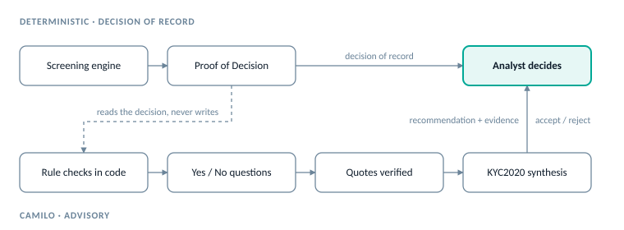
Information flows one way. CAMiLO reads the Proof of Decision and reports to the analyst; nothing flows back into the screening decision.
Nothing clears until a reviewer accepts the whole recommendation or chosen hits, or the client has pre-authorized acceptance through a documented, logged policy rule. Accepted hits clear through the engine’s existing hit-clearing process, in the reviewer’s name.
How CAMiLO reviews adverse media hits: small questions, assembled like an algorithm
CAMiLO never asks “is this a false positive?” It asks small, closed questions, chosen by the article’s category: is there any wrongdoing in the article, is it a FATF predicate offense, and is the person named the actor, an associate, a victim or a bystander? Each is answered from a fixed list, with the sentence that supports it. Code checks that sentence word for word against the article, three runs must agree, and anything uncertain goes to a person. KYC2020 logic, not the model, assembles the answers into a recommendation, and every accept and reject is logged and attached to the Proof of Decision.
How every review improves adverse media data
Each CAMiLO review also teaches our data. When it finds that a person named in an article is a sports opponent rather than the accused, that name is tagged as a non-prime actor in that article. When an article our classifier marked as crime turns out to be a match report, it is tagged as misclassified. Those tags flow back into our article database and categorization pipeline, so the next screening starts from better data.
We never delete or overwrite: every tag adds context alongside the original record, so the history stays intact and auditable. And the tags describe articles, not your customers.
One decision instead of fourteen articles
Back to the screening that embarrassed us. CAMiLO recommended clearing 13 of the 14 hits, each with verified evidence. The last had no article text to check, so CAMiLO didn’t guess; it handed that one to the analyst. One click accepted the 13. CAMiLO brings clarity and speeds action. It never takes away the analyst’s responsibility.
Deterministic first: explainable AI for adverse media screening
We have built screening decisioning since 2016 on one idea: a compliance decision has to be explainable. In adverse media screening, CAMiLO keeps the deterministic engine in charge of the decision, puts AI to narrow, checkable work beside it, and keeps the person in charge of the outcome.
CAMiLO Adverse Media Review is entering beta with select clients. If false positives are eating your team’s week, we’d like to talk.
Adverse media screening FAQ
What is adverse media screening?
Adverse media screening, also called negative news screening, checks news and other public sources for information linking a customer or counterparty to financial crime or related risk, such as fraud, corruption, money laundering or sanctions evasion. It is part of customer due diligence in AML and KYC programs, at onboarding and on an ongoing basis.
Why does adverse media screening produce so many false positives?
Most hits start from a name match. Common names, and exact matches to well-known people, pull in articles where the name appears but the person is not accused of anything: a victim, a witness, an opponent or a sidebar mention. Models that score sentiment and keywords struggle when an article is negative about someone else.
What is the difference between adverse media and negative news screening?
In practice, very little; the terms are used interchangeably. Some teams use negative news for the raw search results and adverse media for findings that are both about the customer and relevant to financial crime risk.
Can AI clear adverse media hits in a way examiners will accept?
AI can support the decision if the decision stays explainable and reproducible. In CAMiLO, the AI only recommends: every answer must cite verbatim article text, results must agree across three runs, models and prompts are pinned so results can be replayed, and a named reviewer accepts or rejects each clearance.
Does adverse media have to involve a FATF predicate offense?
Not necessarily. The FATF designated categories of offenses are a common reference for what counts as financially relevant adverse media, and CAMiLO checks it as one of its questions. Each institution’s risk policy decides which categories matter.